
Harvest Engineering and Management · Second-Crop Corn · Brazilian Scenario
The combine harvester stops in the middle of the field. The truck waits at the headland, the tractor with the grain cart burns diesel while idling, and the harvest window gets a little shorter. On a 1,000-hectare farm, this type of downtime, combined with grain left on the ground, can cost between R$ 95,000 and R$ 188,000 per season.
The bottleneck is almost never where the farmer looks first. During the off-season inspection, attention is mainly focused on the combine’s internal systems. But the machine’s most vulnerable point is the part that comes into contact with the ground: the corn header and the system that controls its height over every meter of uneven terrain.
This article calculates how much it costs to operate without a properly functioning height sensor for a corn header, and shows where that money goes.
Summary for those in a hurry
- The header and feeding system are among the systems that fail most often on a combine harvester.
- Without automatic height control, the header either works too low (causing breakage) or too high (causing ear losses).
- On 1,000 ha of second-crop corn, the combined cost of downtime, parts, and ears left on the ground exceeds R$ 90,000 per season.
- The largest portion of this cost is not the broken part. It is the grain left in the field.
Why the header is the most vulnerable point of the combine
A review published in 2025 in the journal Sensors (Li et al.) on structural failures in combine harvesters shows that threshing, the header, and the transmission account for most of the failures recorded during operation.
This makes physical sense. The header is the first part of the machine to touch the crop and the only one that operates close to the ground. It encounters rocks, soil, stumps, and uneven terrain before any other component. Reliability studies indicate that header and feeding components have the lowest mean time between failures of the machine, well below the engine and electrical system (MTBF of 88.2 hours, according to SAY; IŞIK, 2010).
Mean time between failures, or MTBF, is simply how many hours, on average, a component operates before experiencing a problem. The lower it is, the more often the machine stops.
The challenge of large headers in Brazil
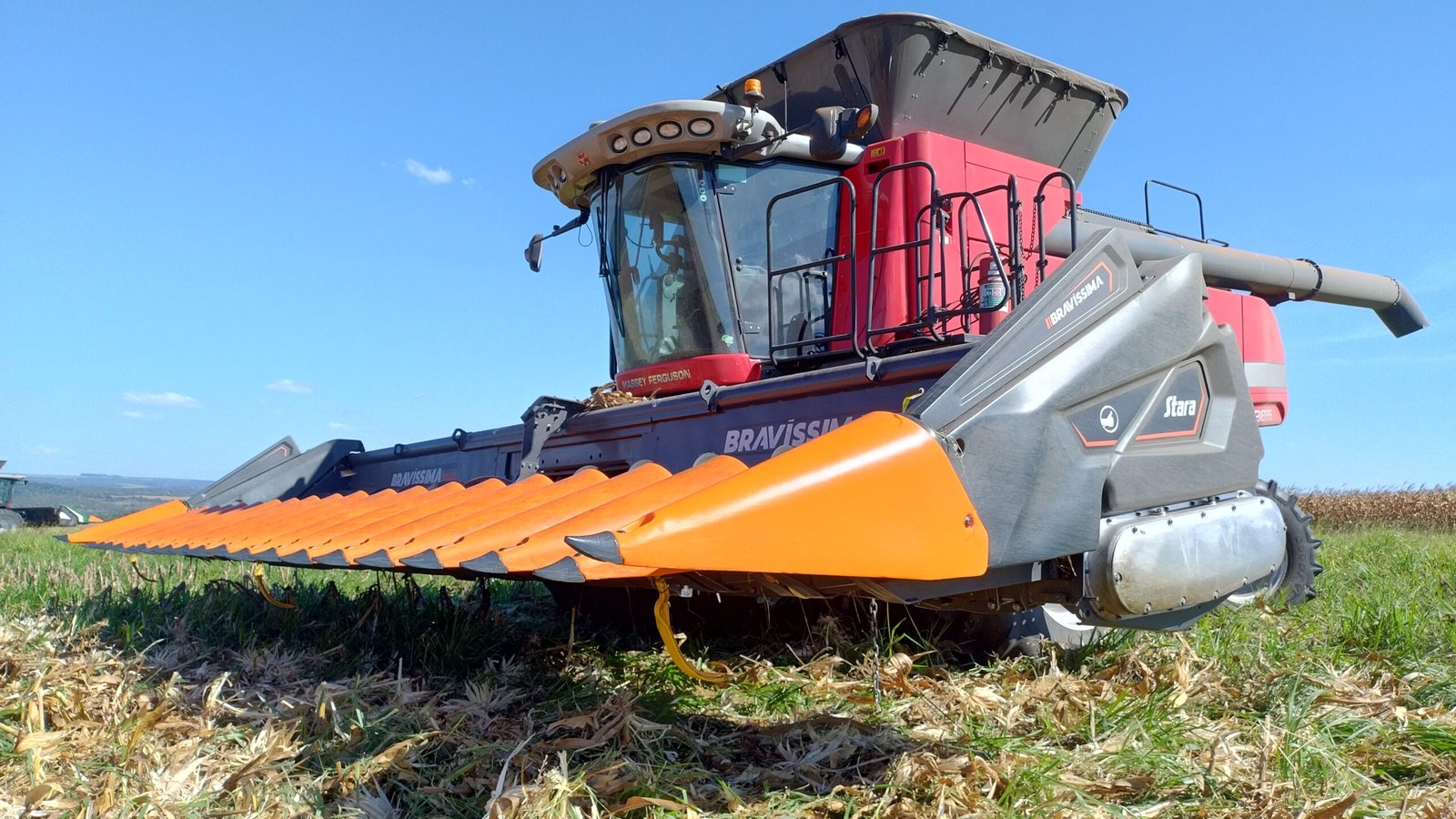
The search for operational efficiency has consolidated large corn headers in Brazil: 15 to 24 rows is the standard, and there are machines operating with 30 rows at 45 or 50 cm row spacing. That means more than 13 meters of working width.
Each row carries a gearbox, a pair of snapping rolls, gathering chains, among other moving and fixed parts. Across such a width, any terrain irregularity becomes a lever. Contour lines, broad-based terraces, or center-pivot elevation changes: while the center of the header is 20 cm above the ground, one end may be touching the soil while the other is 40 cm high.
Without an agile and calibrated height and flotation sensor system, the operator has to make corrections manually. And manual correction always gets one of the two sides wrong.
When the header operates too low
- The snout enters the soil, terrace, or contour line.
- Soil and rocks enter the snapping rolls.
- Snouts break, and chains and shear pins are damaged.
- Row structural supports become bent.
Average field repair time: 1.0 to 3.5 hours per occurrence (estimate based on HarvLabs field experience).
When the header operates too high
- The snouts pass over low-set ears.
- Lodged stalks are not picked up.
- The snouts knock down ears and weakened plants.
- Losses per hectare increase without anyone noticing from the cab.
Agronomic loss: above the tolerable limit of 1.5 bags/ha established by Embrapa.
Why the second-crop harvest makes everything worse
Second-crop corn is planted after soybeans, grows with less water and less sunlight, and reaches harvest with shorter plants and more low-set ears. The stunting complex, which has spread throughout producing regions, leaves plants weak and more susceptible to lodging in the wind.
Add to this the harvest-window pressure: the second-crop harvest takes place during the dry winter, with the risk of late-cycle rainfall in some regions and the need to free the field for the next soybean crop. Farmers harvest at night, with poor visibility, on terrain that has already been worked once that year.
This is exactly the scenario in which the header needs to follow the ground on its own. The lower the ear, the closer the header has to operate to the ground, and the smaller the margin between “picked everything up” and “dug into the soil.”
The loss numbers: how much does a height error cost?
According to ASABE D497 and EP496 standards, international references for agricultural machinery management, the actual field efficiency of a combine harvester is between 65% and 75%. The rest is lost in headland turns, unloading, and unplanned corrective downtime.
Ground-following problems and snout impacts represent a significant share of this downtime. In an uneven field, this represents between 4 and 6 hours of combine downtime over a 1,000-ha season.
The calculation below uses a base area of 1,000 hectares and corn priced at R$ 60 per bag.
| Loss category | How the loss occurs | Calculation basis | Impact per season |
|---|---|---|---|
| Unproductive fleet hours | Combine, tractor with grain cart, and truck stopped waiting for a snout repair or shear-pin replacement. | Fleet cost of R$ 350 to R$ 500 per hour (Brazilian estimate using ASABE D497 methodology) over 4 to 6 hours of downtime. | R$ 2,000 to R$ 3,000 |
| Field parts and maintenance | Replacement of snouts, bent supports, chains, and gears damaged by impact. | Approximately 4.3 field mechanical interventions per season (in a 1,000-ha operation harvested over 30 days). | R$ 3,000 to R$ 5,000 |
| Ear left in the field | Header operating too high and passing over low-set ears or lodged stalks, aggravated by nighttime operation. | Loss of 1.5 to 3 bags/ha beyond the tolerable level over 1,000 ha at R$ 60/bag. | R$ 90,000 to R$ 180,000 |
| Estimated total per season (1,000 ha) | R$ 95,000 to R$ 188,000 |
Notice the proportion. Under “normal” conditions where there is no major damage, the cost of parts and downtime is less than 5% of the loss. Grain left on the ground accounts for more than 95% of the total. This is why Embrapa points to ear losses at the header as the largest contributor to total losses in mechanized corn harvesting.
How to know if your header has this problem
If two or more of the items below occur during your harvest, the bottleneck is probably related to header height:
- The operator makes several steering corrections per minute on contour-line terrain.
- A shear pin or snout needs to be replaced more than once per season.
- Speed decreases at night because the operator cannot see the ground.
- The loss tray shows whole ears behind the header, not just loose grain behind the machine.
- The rows at the ends break more often than those in the center.
- The automatic system exists, but remains turned off because “it doesn’t follow the ground properly.”
What a properly calibrated height sensor system gives back
Automatic header height control (AHHC) is the system that reads the ground in real time and raises or lowers the header automatically, without requiring the operator to make corrections. With modern ground-following sensors and proper calibration, the benefits appear as early as the first season:
- Maximum pickup of lodged corn. The header operates steadily close to the ground profile and picks up low ears and lodged plants. According to Embrapa Maize and Sorghum, this is the largest fraction of losses in mechanized corn harvesting.
- Structural protection. The hydraulic block compensates for contour-line and terrace elevation changes in milliseconds, before the end row digs into the soil.
- Uniform speed, including at night. With the control active, the operator maintains a constant pace. The height control system allows an average speed increase of 1 to 2 km/h, resulting in an increase in capacity of around 16% (considering an initial speed of 5 km/h).
- Less fatigue. Dozens of corrections per minute are eliminated. The operator can focus on the path, engine, and row alignment.
Not every sensor delivers this. Contact sensors with resistive tracks wear out due to dust and vibration and lose accuracy throughout the season. This is why HarvLabs developed Hall-effect sensors, which take measurements through a magnetic field, without physical contact or wear parts, integrated with the ISOBUS terminal already in the cab, on combines of any brand. All of this has been validated in Brazilian fields at Biopark in Toledo, Paraná.
Frequently Asked Questions
What is a corn header height sensor?
It is the component that measures the distance between the header and the ground and sends this reading to the combine controller, which automatically adjusts the height. Without it, adjustment depends on the operator.
How much corn is it acceptable to lose during harvest?
Embrapa considers up to 1.5 bags per hectare tolerable. Above that, it is worth investigating the header, speed, and settings.
Does automatic height control work on an older combine?
Yes, provided that the combine already has electrical header control. HarvLabs systems were designed for installation on machines from different brands with analog or ISOBUS systems.
How do you measure header losses?
Using an Embrapa loss tray or measuring cup, collecting ears and grain over a known area immediately behind the header, before the entire machine passes over it. The result is expressed in bags per hectare.
Conclusion: margin protection, not convenience
On 15- to 30-row headers, height control is no longer a comfort feature. A single impact on a terrace that bends a row structure costs more in downtime and parts than a HarvLabs sensor kit. And the ear left on the ground costs ten times that.
We have already shown why most harvest losses occur at the header, not at the threshing system. Field data are available on our Field Trial Evidence page.
Want to know whether your header can receive a height sensor system without replacing the machine? Request a quote or learn about the technology.
Technical Sources and References
- Li, X. et al. (2025). Structural Fault Detection and Diagnosis for Combine Harvesters: A Critical Review. Sensors, 25(13), 3851. PMC12251867.
- SAY, S. M.; IŞIK, A. Reliability Analysis of Combine Harvesters. Tarım Makinaları Bilimi Dergisi (Journal of Agricultural Machinery Science), v. 6, n. 1, p. 5-12, 2010. Available at: https://dergipark.org.tr/en/download/article-file/556777. Accessed September 2, 2026.
- ASABE Standards. ASAE D497.7 and EP496.3: Agricultural Machinery Management Data. American Society of Agricultural and Biological Engineers.
- Embrapa Maize and Sorghum. Harvest Losses. Embrapa Technological Information Agency. Embrapa / Fundação ABC: Losses in Mechanized Corn Harvesting.